
High-Concentrated Reactive Oxygen Species from Chiral Thyroxine for Piezocatalytic Antitumor Therapy
Zhilin Yang1, Nan Yuan2, Yaning Gong1, Yang Jiao2(焦旸)*, Najun Li1(李娜君)*, Jianmei Lu1(路建美)*
1College of Chemistry Chemical Engineering and Materials Science, Collaborative Innovation Center of Suzhou Nano Science and Technology, Soochow University, Suzhou 215123, China
2State Key Laboratory of Radiation Medicine and Protection School of Radiation Medicine and Protection Collaborative Innovation Center of Radiological Medicine of Jiangsu, Higher Education Institutions, Soochow University, Suzhou 215123, China
Adv. Funct. Mater.2026, 36, e19435
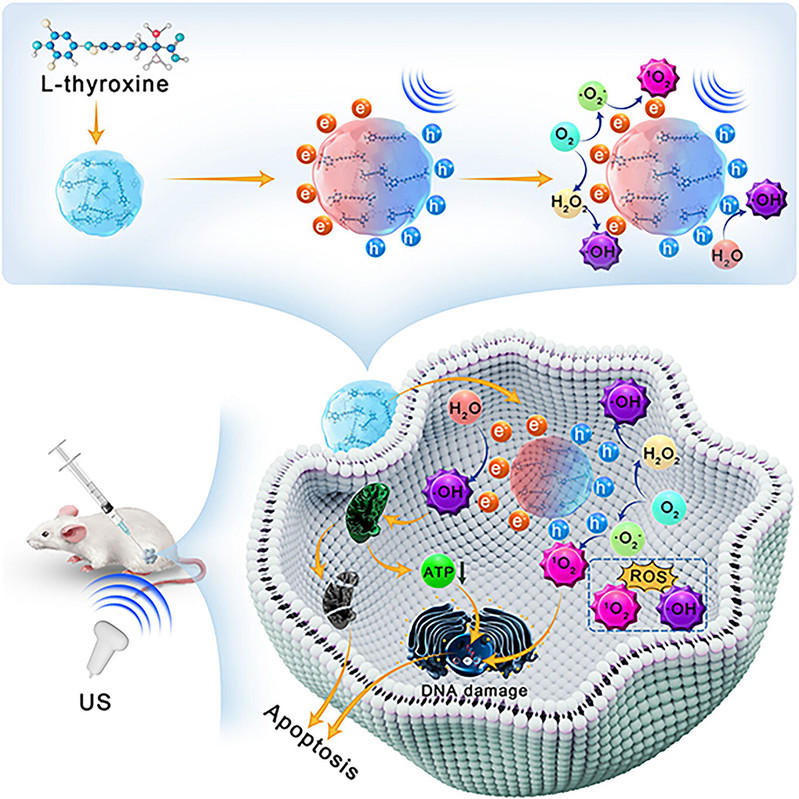
Abstract: Piezocatalytic therapy based on piezoelectric nanomaterials has emerged as an effective strategy to induce the generation of reactive oxygen species (ROS) for tumor inhibition. But the biocompatibility and toxicity risks during treatment and metabolic processes of the inorganic piezoelectric materials are big obstacles for their clinical application. As an alternative, L-thyroxine, an endocrine hormone with high biocompatibility, is selected for piezocatalytic therapy testing based on its piezoelectric catalytic activity derived from its chiral confirmation. Without any complex synthetic process, the water-insoluble L-thyroxine molecules can well self-assembled into small particles with a diameter about 100 nm in physiological medium, and then effectively taken up by 4T1 breast tumor cells. The high-concentrated ROS is stimulated by L-thyroxine under ultrasonic vibration, thereby effectively inhibiting tumor growth. In vitro results demonstrate the high biocompatibility of L-thyroxine, while in vivo results achieve a remarkable tumor inhibition rate of 81.2% against 4T1 breast tumor cells under ultrasound treatment, thereby validating the effectiveness and potential of endogenous chiral molecules in piezocatalytic therapy.
Article information: https://doi.org/10.1002/adfm.202519435